It’s all elementary
This blog moves to the third and final epoch of The Rise and Fall of Antocracy. In this epoch, we return to Poo-ponic’s moon Bilaluna right after the rebels arrive in their effort to escape Antilla’s wrath. The tenth chapter starts with one of my top three favorite poems; Narrant outdid himself with this one. Here’s the poem:
Wisdom is the water that douses the fire of reckless intelligence,
and enlightenment is the air that raises the phoenix from its earthly ashes.
’Tis this ethereal mix fills voids and spawns altruistic give from egotistic want.
The point of this poem is to contrast the difference between intellect and wisdom. Until this point in the novel, the insects have become increasingly intelligent, but their intellect has not yet translated into the deeper insight that would qualify as wisdom. In chapter 10, the rebels learn from the mistakes that led to the fall of antocracy and create a political system that overcomes earlier pitfalls. The beauty of Narrant’s poetic style is how he uses the four Earthly elements, described by Aristotle, as metaphors for lessons learned (earth), enlightenment (air), wisdom (water), and reckless intelligence (fire), once again showing his knowledge of human philosophical thinking. He further uses the classical element ascribed to the heavens and a more modern one attributed to space as metaphors for combined wisdom and enlightenment (ether) and personality flaws (voids) in his description of how the former can transform the latter, egotistic want, into altruistic give. Here, Narrant alludes to his earlier poem that referred to Freud’s personality development from a state where ego is all-important to a condition where empathy emerges and enlightenment becomes possible. Narrant also references Greek mythology when he describes a phoenix rising from the ashes to provide an analogy for how the insects on Bilaluna emerge from the catastrophe on Poo-ponic as stronger and wiser than their ancestors.
Green is good when you’re blue!
As our protagonists continue the journey on Bilaluna in Chapter 11, they have solved their political issues. Still, their practice of taking essence from plants and burning trees to convert essence and sap into honey continues to cause the same environmental problems that destroyed Poo-ponic. They slowly learn that the solution to their dilemma comes from unexpected places, which is highlighted in the opening poem. Here’s the poem:
As the celestial ball of fire scorches the veneer,
’tis the sage that strips to the silvery undercoat and allows the broth to season.
And though the unripe may be green,
like copper mixed with soupy air, their hue may early stew with reason.
In this poem, Narrant makes use of the adage ‘for every dark cloud, there is a silver lining.’ However, the dark cloud is a celestial ball of fire or a meteorite strike, and the silver lining, or silvery undercoat beneath the veneer, is the opening of another wormhole. Sage refers to the wise individual recognizing how tragedies sometimes bring solutions if allowed to season. Yet since Narrant’s imagery often involves food, he also knows that sage is a spice used to season a broth. And what comes through the wormhole but young (unripe) children, who are naïve (green), but whose manners (hue) may mature (stew) with surprising logic (reason) when the conditions are right. And Narrant knows the shade of copper quickly turns green as it oxidizes in humid (soupy) air, which allows additional foodie wordplay. All this talk of spicey broths, soups, and stews gave Narrant a chance to throw in another poetic staple, as he rhymes season with reason. And just like copper quickly turns green when conditions are right, so sometimes too, does reason season when the young are challenged, but it takes a sage to realize it.
When seeds get seedy!
The poem that opens Chapter 12 continues the theme of the preceding one, just as the chapter continues to explore the wisdom of the young. Here’s the poem:
Naivety is oft the seed of youthful exuberance.
Yet, as naivety germinates, it is fodder for fear, obstruction, and consternation.
But we call it worldly when the pureness of our nature becomes adulterated.
Once again, Narrant focuses on naivete, but this time drops the food theme for one that centers on growth. The words seed, germinate, youthful, and adult all reflect growth. But once again, Narrant looks back to an earlier poem about nurture versus nature when he ponders how maturing and what we learn sometimes takes us away from a less corrupted innocence of youth. And his final line is a commentary about how teachings intended to educate us in the ways of the world can turn us, or our society, in the wrong direction and asks us—is to become worldly to become adulterated? And sometimes, cannot our youthful perspective be more mature? Is it not fitting that children point to the solution that has eluded the adults in this story?
The large and small of it!
Chapter 12 has a second poem at its end that sums up the entire novel. It is really a sentiment that outlines contrasting styles in modern and ancient politics, yet also continues Narrant obsession with rhyming not only at the end of the lines in poetry, but throughout. Here’s the final poem:
Be the species big or small,
there is neither vice so insipient as willful ignorance,
nor virtue so percipient as witting intendance.
The first line, of course, refers to insects and humans. It alludes to the reality that despite their vast differences in size, there are highly significant similarities in their behaviors and underlying motivations. And continuing with the theme of similarity, the words vice and virtue were chosen because they start the same way, despite having completely opposite meanings. And the key rhyming words I referred to earlier are insipient and percipient, selected not only because they rhyme, but because of the perfection of their meaning in the context of each line. Please don’t conflate the word insipient with the more commonly used homonym incipient. Insipient is a little-used archaic word that means ‘lacking wisdom, stupid, or foolish.’ So, the line then means nothing can be worse than a foolish politician that is purposefully ignoring reality and misleading his/her followers. And like vice is to virtue, insipient and percipent are similarly constructed words that once again have opposite meanings. The be percipent is to be perceptive, and to have an excellent understanding of things, an antonym of foolish or insipient. Then, of course willful ignorance and witting intendance were penned to follow the poem’s trend of having parallel words sound alike despite their contrasting meanings. Intendance is another archaic word, which means stewartship, or to take care of others in an administrative sense. So, a politician that practices witting intendance is doing the opposite of one that is willfully ignorant. Narrant and the author hope that you will consider which world leaders in recent years have practiced willful ignorance, versus those that exhibit witting intendance. The latter may be less exciting, but it will keep you whole and keep you safe, while the former may lead the world down a path towards destruction.
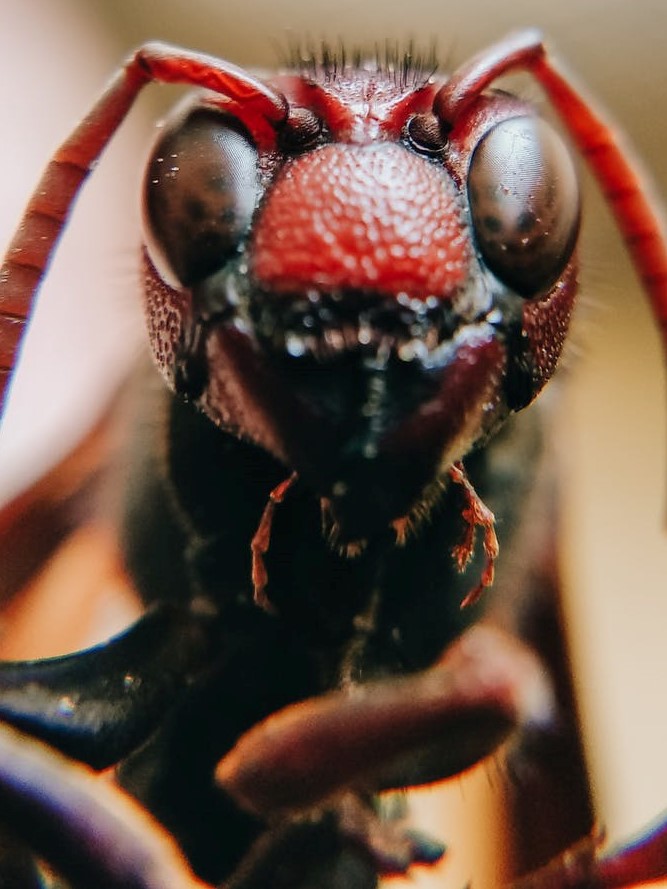
This is Narrant below wearing his serious face. Doesn’t he look like he means what he says?