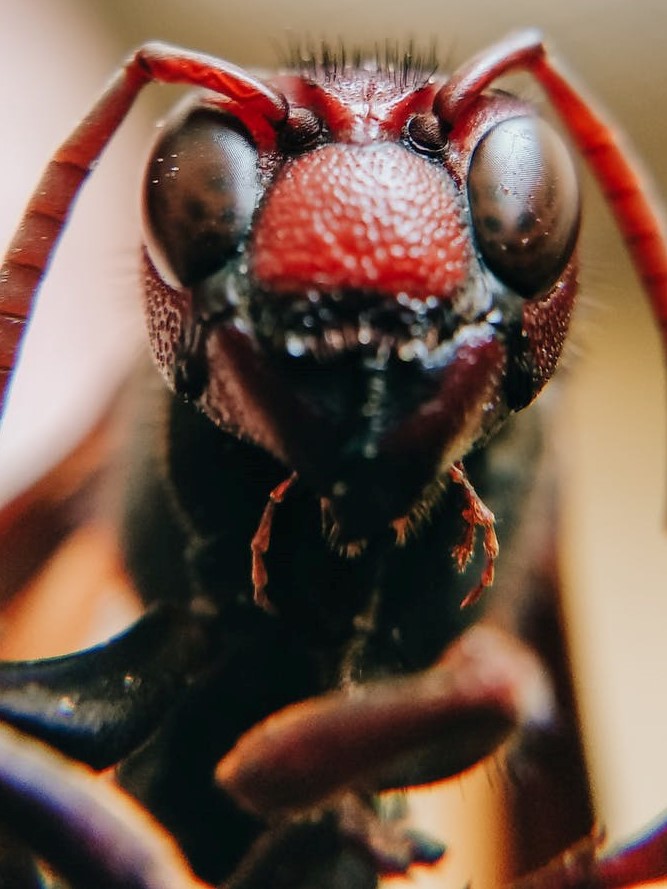
Doctor Fudge creates some sludge
We move now to the poems of chapters 4-6 of The Rise and Fall of Antocracy. And this is where the verse gets more interesting. As one might expect, the lyrics get more complex as the plot gets more complicated, providing more fodder for wordplay. Here is Narrant’s poem for chapter 4, one of my personal favorites:
Deception is the master of corruption.
Not a surgeon but it doctors, not a baker, but it fudges.
And when it cuts or takes a slice, the knave be sharper than the knife.
And the needless loss of life becomes a relative indignancy
when the doctor’s orders have baked in malignancy.
It is in chapter 4 that Antilla begins to spread his wings or stretch his evil claws. At the advice of his father Antrich, Antilla begins to deceive the electorate, aiming to cement his power. With his father’s guidance, he realizes his popularity will soar if he can win a war against a nearly defenseless enemy of small insects. He uses deception to convince his followers that small insects are causing an infestation that will kill all the plants the insectoids need to gather the essence required for making honey. And herein lies a vital lesson of the entire book: corruption has no exoskeleton without deception.
Narrant has told me that if he wasn’t a historian, he dreamed of working as a surgeon or a baker. So naturally, he uses these two professions to make his point. He then uses some wordplay by employing the words doctor and fudge to represent deception and cuts or takes a slice to denote corrupt intent. Then he juxtaposed the words knave and knife to imply that deception is often more effective than force. Finally, Narrant cleverly rhymed indignancy with malignancy as a reference to the unnecessary war that Antilla started, which inflicted an unwarranted loss of life like cancer. And although usually a surgeon is charged with removing fatal tumors, the tyrant who doctored this deception gave orders that killed millions. Narrant reminds me to point out that the baked-in malignancy Antilla cooked up brings us back to his other favorite profession.
Dots, lots and plots
Narrant’s poem for chapter 5 continues Antilla’s quest for more power, a dominant theme in the chapter. Here’s the poem:
Like toppled dominoes in a line, the numbers fell to his dominance.
Like spinning power balls in a drum that dance,
the lots were drawn down the tubes by the chance to know his power.
But all too soon, the jitterbug vibe swung from glee to cower.
Narrant explains that dominoes is one of his favorite Earthly games. He notes that the game’s name may have origins in the tiles’ similarity to dark spots on the white faces of those wearing masquerade masks with eyeholes (known in some cultures as dominoes). So, wearing a mask again brings us back to deception, hiding one’s face or facial expressions that might reveal truths. But also, domino is the root of the word dominance, and many who are dominated fall like dominoes to the leader’s will.
Narrant says he is also fascinated by gambling and the lotteries humans play. He finds it funny that the biggest of these is called Powerball. So, he uses this game to create a wordplay around the word power. He employs the words numbers from dominoes and lots from Powerball as symbolism for the individuals that a leader dominates. So, just as numbers fall like dominoes, the lots are drawn down the tubes, is an analogy for subjects that are led down the wrong path by a deceitful leader. Narrant then rhymes the word chance with dance, both to remind you that a corrupt leader is playing a game when he gives others a chance to know his power, and he thought it would be fun, as an insect, to refer to his favorite dance – of course, the jitterbug. Yet, Narrant knows the jitterbug is a carefree type of dance, so he uses that sentiment to contrast with the typical result for those living under unchecked power, which is expressed with the rhyming word cower.
Pheromones and tombstones
The poem for chapter 6 is a short but inspiring one. Chapter 6 is mainly about the trials and tribulations of a small group of insectoids that lead a rebellion against Antilla’s autocratic rule. This group includes the novel’s main protagonists, Anthiery and Antianna, and their colleagues and friends who stand up to Antilla. In the end, they decide that their only hope to stay alive is to escape to the planet’s moon. Here’s the poem:
What is bravery but to stand up to slavery and characters unsavory?
To buck the fearful throngs and call out your leaders’ wrongs.
And comport not as the fowl when your name risks food for gravery.
You may have noticed by now that Narrant has an unorthodox way of rhyming throughout his lines of poetry and from the end of one line to the next. If you read the novels of The Antunite Chronicles, you will see many examples of how, in formal circumstances, insects choose to use poetry to make an impact. Of course, insects speak with pheromones, and pheromonal speech requires chemical formula. So, to rhyme two lines in a row, you need to end each line with the same chemical structures, like two aldehydes or two alcohols, esters, or ketones. Narrant found it challenging to translate insect pheromones into English, but also found it liberating because of the more diverse word choices in English compared to pheromonics. So, his text is not a direct translation of the history of Poo-ponic and Bilaluna, but a story rewritten to reflect what happened using English words and human references that ordinary insects would not understand. All this to say, Narrant admits he got carried away with how easy it is to rhyme English words for these poems.
In this poem, Narrant rhymed bravery, slavery, and unsavory all in the first line. But what an apt line for the courage it took for our heroes to challenge Antilla. Yet, with the choice of the third word, Narrant brings in another theme for this poem. So, while unsavory reflects Antilla’s morally disreputable character, the term is also selected to make the reader think of savory foods. Then after rhyming throngs and wrongs, the food theme is carried on to the poem’s last line, which refers to chicken (or to be afraid) as fowl, and to the final rhyming phrase, food for gravery, which ends with an obscure word that sounds like gravy, but has the root grave. Gravery is a variant of the word engravery (i.e., engraving), so food for gravery is a metaphor for the writing on a tombstone, and to risk that is to tempt death or to use an idiom–dig one’s own grave.